Great coaches are built over years, not appointed overnight. And right now, the biggest entertainment product on the planet makes that case better than any coaching manual.
Grand Theft Auto VI arrived with a November 19, 2026 launch date, about 13 years after GTA V. Along the way, Rockstar Games pushed it back twice: from a fall 2025 window, to May 26, 2026, and then to November. Each time, the message was the same. It would ship when it was ready, not before.
You don't need to have played a minute of it to learn from how it was made. Strip away the car chases and the neon of Vice City, and you find four ideas that every basketball program should steal for how it develops coaches:
- Patience. Long development cycles produce better finished products.
- Partnership. Two protagonists, each covering what the other can't.
- Open-world learning. Structured missions matter, but most growth happens when you explore.
- The skill tree. Coaching is a set of distinct competencies you level up on purpose.
Whether you're a club president or technical director appointing staff, a head coach building a bench, or a young assistant wondering when your chance will come, here's what the game can teach you.
1. Built, not rushed: the case for long development cycles
The most valuable thing a program can give a developing coach is time to get the reps that matter. Rockstar had a fixed launch date, enormous commercial pressure and millions of fans counting down, and still chose to delay rather than ship something unfinished. Basketball clubs face the same pressure, and they usually give in.
The "rushed release" problem in coaching
We all know the pattern. A talented assistant has one good NBL1 season. A head coaching role opens up, the board wants a young, energetic appointment, and the assistant takes it. Two years later they've been sacked, and the club is starting again.
The assistant usually had the talent. What they missed were stages of development. They had never written a full training plan from scratch, handled a difficult situation alone, managed a budget, or sat in the chair when a season fell apart mid-winter. Those gaps show up later, and they show up in public.
In game development, that's a "day-one patch": the problems ship with the product and get fixed in front of everyone. In coaching, the patching happens in front of players, parents, the committee and sponsors. That costs the coach credibility and costs the players a season.
What a proper development cycle looks like
A well-built coach moves through clear phases, and each one has a purpose:
- Pre-production (the volunteer, team manager or video coordinator years). Learn the language of the game, how training is structured and how a staff works. Mostly you watch and absorb.
- Alpha (the junior assistant). Own a small piece outright, like the bigs or guards at training, an under-16 rep side, or the opposition scouting report. Make mistakes when they're cheap.
- Beta (the senior assistant or associate head coach). Run things while someone experienced still has the final say. Run training sessions, handle player meetings, take a game when the head coach is away.
- Launch (the head coach). Own every decision and live with the results.
The mistake is skipping beta. Plenty of coaches go straight from "good assistant" to "head coach" without ever owning decisions while someone was there to catch them.
Delays are not failures
GTA VI's delays didn't damage it. If anything, waiting raised expectations of the finished product. The same goes for coaches. Turning down a head job, or taking one more year as an associate head coach, is often the most ambitious choice you can make, not the timid one.
For club boards, technical directors and head coaches:
- Appoint for readiness, not just potential. Ask candidates which decisions they have actually owned, not just which programs they've been part of.
- Build real "beta" roles into your staff, with defined areas of ownership, so assistants arrive at their first head job already tested.
- Judge your coaching staff over years, not single seasons.
For developing coaches:
- Map your gaps honestly. Which parts of the head coach's job have you never done yourself?
- Ask for ownership before you ask for a title.
- Remember that no one ever lost a career by being ready too early.
2. Two protagonists: the head coach and assistant partnership
The best coaching staffs work like a duo, not a hierarchy with helpers attached. GTA VI is built around two leads, Lucia and Jason, a Bonnie-and-Clyde-style pairing. Neither is a sidekick. The story depends on what each brings and on whether they can trust each other when things go wrong.
Leave out what the characters actually get up to, and that's a useful model for the relationship at the centre of every program: the head coach and their lead assistant.
Complementary, not identical
The most common appointment mistake is cloning yourself. A head coach who is a brilliant offensive mind and a natural motivator often hires an assistant who is... a brilliant offensive mind and a natural motivator. It feels comfortable. It leaves the same blind spots on both sides of the bench.
Strong pairings are deliberately different. For example:
|
If the head coach is... |
The lead assistant might be... |
|
A big-picture culture builder |
A detail-driven training planner and scout |
|
An intense, emotional sideline presence |
A calm voice players can come to after a tough loss |
|
An offensive systems coach |
A defensive specialist who owns that end |
|
Strong with the board, sponsors and the association |
Strong with players' day-to-day lives and families |
|
A veteran with established methods |
A younger coach fluent in analytics and video tools |
The goal isn't opposites for the sake of it. Between the two of you, every part of the job should be covered by someone who's good at it.
Trust is the real mechanic
In any two-hander story, the drama comes from trust: who has whose back, and what happens when one partner doubts the other. Coaching staffs live or die on the same thing.
Trust between a head coach and assistant shows up in practical ways:
- Disagree in private, unite in public. The assistant should push back hard in the office and never undercut the head coach in front of players.
- Real ownership, not fake delegation. If the assistant owns the defence, the head coach doesn't override every coverage call during a game.
- Shared credit. When the media ask about the win, name the assistant who built the game plan.
- Honest feedback upward. The best assistants tell the head coach what nobody else will, like "the players have stopped listening in timeouts."
The partnership is a development engine
This is where the duo connects to coach development. A strong partnership is the best "beta" environment an assistant can get (see Part 1). They make real decisions with a trusted partner beside them, and they see up close how the head job actually works.
It develops the head coach too. Working with someone who thinks differently stretches your own coaching, and having an honest partner protects you from your own worst habits.
Questions to ask your staff this season:
- What does each of us own outright?
- Where do our strengths overlap so much that we're leaving a gap somewhere else?
- When did one of us last change the other's mind? If you can't remember, something's wrong.
- If our lead assistant left tomorrow, what would we lose that no one else provides?
3. Open-world learning: missions vs. exploration
Formal courses give a coach structure, but most real growth happens when coaches go exploring on their own. Open-world games like GTA hand you two kinds of progress. There are story missions: linear, designed, with clear objectives. And there's everything else: a huge map you can roam, where you pick up skills, find secrets and run into experiences nobody planned for you.
Coach development works the same way, and most programs only invest in the first kind.
The story missions: structured learning
These are the designed, linear parts of a coach's education:
- Basketball Australia and state association coach accreditation courses
- Coaching clinics and conference sessions
- Formal mentoring programs with set meetings and goals
- University sport-coaching qualifications
- Working with Children Checks, child safeguarding and first-aid training
They matter. They give you a shared language, safe practice, credentials, and a baseline everyone can rely on. But they're built for the average coach, they're paced by someone else, and they can only teach what can be taught in a room.
The open world: self-directed learning
This is where coaches tend to grow the most, and where development budgets almost never go:
- Film study, done with a purpose. Not just watching your next opponent. Study a coach you admire across a whole NBL season and chart how their sets change from round 1 to finals.
- Club visits. Spend a week at another club's training sessions.
- Other sports. AFL defensive structures, netball's spacing and movement, an A-League academy's approach to small-sided games. Ideas cross over well.
- Informal mentors. The retired coach who'll meet for coffee. The veteran rival who answers your texts. These relationships often teach more than formal ones.
- Coaching up and down. Run a school holiday clinic, coach a rep team, help out with an under-12 domestic side. Explaining the basics to beginners shows you how well you really understand them.
- Reading outside basketball. Leadership, psychology, teaching and learning science. The best coaches are teachers first.
There's a reason GTA players spend hours away from the main story. Exploring is where you get good at the game in your own way. A coach who only does structured learning ends up competent and interchangeable. A coach who explores develops a style of their own.
Side quests are not distractions
In open-world games, side quests often turn out to matter more than they first appear. The skill you picked up on a detour is the one that gets you through a main mission later.
In coaching, the "side quests" are the jobs that look like detours: running a holiday camp, organising travel to a national junior championship, helping the strength and conditioning coach, coaching a team two levels below where you want to be. Each one builds something the head job will eventually ask of you, whether that's logistics, relationships, organisation or patience.
Balancing the two
The best development plans mix both modes deliberately. A practical approach:
- Set your story missions each year. One or two formal goals, like the next accreditation level or a specific clinic.
- Pick one exploration theme per season. For example: "This year I'm studying transition defence across three levels and two sports."
- Keep a learning log. Write down what you saw, what you'd steal and what you'd never do. Exploring without reflecting is just sightseeing.
- Debrief with your partner. Bring what you found back to your head coach or assistant (Part 2) and test it together.
4. The coach skill tree: leveling up on purpose
Coaching isn't one skill. It's several distinct ones, and coaches develop fastest when they can see which branches are strong and which they've barely started. Most modern open-world games, GTA included, track how your abilities grow with use. Role-playing games go further with a skill tree: a map of abilities, where you unlock new tiers by investing in a branch.
That's a useful way to think about a coaching career. Instead of a vague goal like "become a better coach," you get a map: six branches, each with three levels.
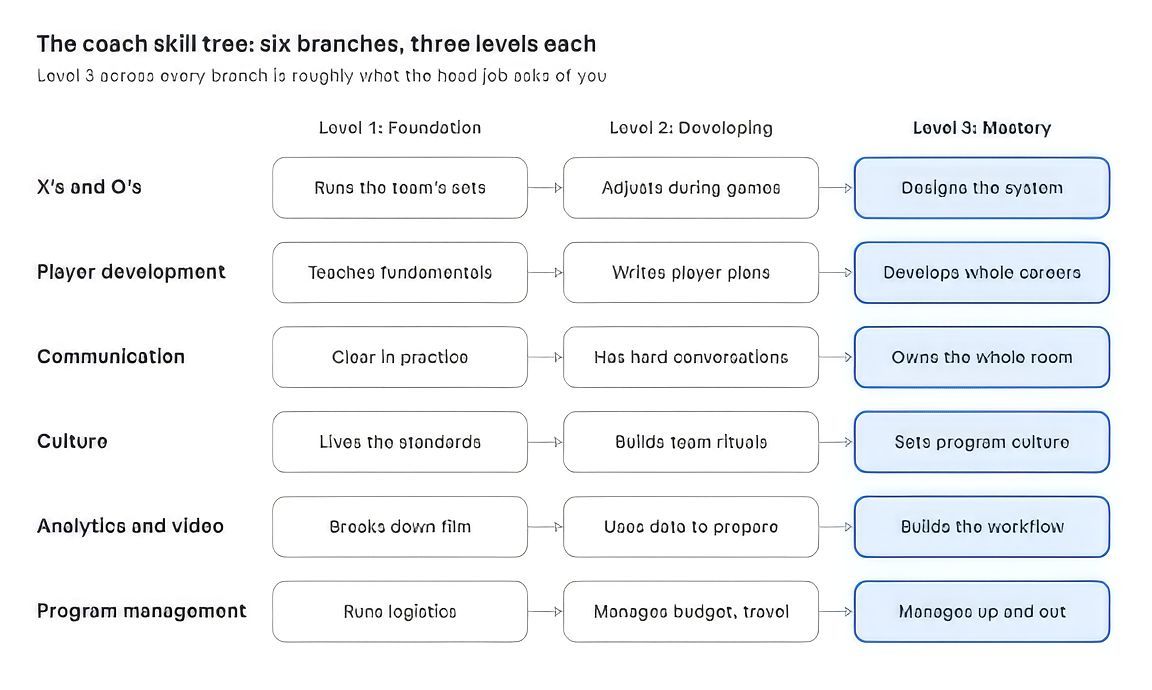
Read each row left to right. Almost every coach is lopsided, and that's normal. The point is to know your shape and invest on purpose.
The six branches
- X's and O's. The tactical game: offensive and defensive systems, set plays, in-game adjustments. This is where most coaches put almost all their skill points, because it's the most visible and the most fun.
- Player development. Making individual players better, from teaching footwork and shooting mechanics to building long-term plans that span a player's whole time in your program.
- Communication. Being clear in a 60-second timeout, honest in a conversation about game time, persuasive with a reluctant veteran. It applies to players, parents, staff and media.
- Culture. Setting and living the standards, the rituals and the language of a program. Culture is built from small, consistent details, much like a game world feels real because of thousands of small touches.
- Analytics and video. Breaking down film, using data to prepare and evaluate, and building a staff workflow so insights actually reach players. This is often the branch where younger coaches start ahead.
- Program management. Logistics, budgets, travel, scheduling, compliance, and managing relationships with the club committee, your association and the community. It's rarely taught, and it gets plenty of new head coaches sacked.
The "all points in one branch" trap
In RPGs, players who dump every point into one branch often build something powerful but fragile. They dominate in one situation and fall apart in the rest.
Coaching has the same trap. The tactical genius who can't communicate loses the playing group. The great motivator with no program management skills drowns in admin by mid-season. When head-coaching appointments fail, it's usually because of a weak branch the coach never developed, not a lack of basketball knowledge.
This connects straight back to Part 1. A long development cycle exists so coaches can fill in their weak branches before the stakes get high.
How to use the skill tree
- Self-assess. For each branch, mark your honest level, 1 to 3. Then ask your head coach or partner to do it for you, and compare. The gaps between the two are where the useful conversation is.
- Pick one branch to push this season. Not six. Choose one weak branch to lift a level, and maintain the rest.
- Match the branch to the learning mode. Some branches level up through structured learning (Part 3's story missions). Others need exploration or simply ownership. Program management, for example, mostly grows by being handed real responsibility.
- Use the tree in staff reviews. Swap generic feedback for specifics: "You're Level 3 in X's and O's and Level 1 in program management. Next year you're running our travel and budget."
- Appoint against the tree. When building a staff, map each coach's branches. Cover the head coach's weak branches with an assistant who's strong there .